



How To Choose The Right IP Rating For Outdoor Lighting In The UK
How To Choose The Right IP Rating For Outdoor Lighting In The UK
Why IP Ratings Matter for Outdoor Lighting
When planning a garden lighting scheme or upgrading security illumination around a property in the United Kingdom, it is easy to become captivated by the aesthetic possibilities. Whether focusing on the warm glow of deck lights, the dramatic silhouette of up lighting on an oak tree, or the sleek modern lines of a driveway bollard, design often takes centre stage. However, living in the UK means contending with a climate that is notoriously unforgiving to electrical equipment. From the persistent drizzle of a grey November afternoon to the torrential downpours of a summer storm, outdoor fixtures face a constant barrage of environmental stress. This is precisely why understanding IP (Ingress Protection) Ratings is not merely a technical nuance—it is the absolute cornerstone of a safe, durable, and legal outdoor lighting installation.
At its core, an IP rating is a globally recognised standard (defined in international standard IEC 60529) that classifies the degree of protection provided by mechanical casings and electrical enclosures against intrusion. The code consists of the letters 'IP' followed by two digits: the first indicates protection against solids (like dust, dirt, and insects), and the second indicates protection against liquids (specifically water). While this might sound like dry technical jargon, for a homeowner or electrician, these numbers are the difference between a lighting system that lasts for decades and one that fails within months.
The Safety Imperative
The primary reason IP ratings matter is, unequivocally, safety. Water and electricity are a lethal combination. In the UK, outdoor electrical installations must adhere to strict safety standards, such as BS 7671 (The IET Wiring Regulations). Installing a light fixture with an insufficient IP rating—for instance, using an IP20 indoor downlight on an exposed porch—invites moisture to penetrate the housing. This water ingress can lead to short circuits, trips in your fuse box (consumer unit), fire hazards, and, in grand worst-case scenarios, the risk of electrocution. ensuring the correct rating is essential for compliance with Part P of the Building Regulations, which governs electrical safety in dwellings.
Durability and Economic Sense
Beyond the critical safety aspects, ignoring IP ratings is economically imprudent. The sheer variability of British weather—high humidity, frost, rain, and even salt spray in coastal areas—acts as a corrosive force. A fixture that is not adequately sealed will suffer from corroded contacts and waterlogged components. This leads to the frustrating "buy cheap, buy twice" cycle, where homeowners find themselves stripping out rusted fixtures after a single winter. By selecting the appropriate rating, such as IP44 for sheltered walls or IP65 for exposed garden areas, you ensure the longevity of your investment, saving significant money on replacement parts and labour costs over time.
Reliability and Performance
Finally, the correct IP rating ensures consistent performance. There is nothing more aggravating than a security light that flickers due to dampness or fails to trigger when needed because condensation has fogged the sensor. High-quality outdoor lighting is designed to withstand the contraction and expansion caused by changing seasonal temperatures, maintaining a hermetic seal against the elements. By prioritising the correct IP specification from the outset, you guarantee that your lighting scheme remains as functional and beautiful as the day it was installed, regardless of what the Great British weather decides to do.
Understanding the UK Climate: Rain, Wind, and More
To select the correct Ingress Protection (IP) rating for your external fixtures, one must first appreciate the unique hostility of the British climate. While the United Kingdom is rarely subjected to the extreme hurricanes or monsoons found in other parts of the world, our weather is famously unpredictable and persistently damp. It is a common misconception that outdoor lighting need only survive a gentle shower; in reality, fixtures must withstand a rigorous assault from moisture, particulate matter, and fluctuating temperatures throughout the year.
The Pervasiveness of Precipitation
The most obvious adversary for outdoor electrics is rain. However, simply looking at annual rainfall totals does not tell the full story. According to Met Office climate data, the UK experiences significant variations in precipitation intensity. In exposed areas, particularly in the west and north, rain rarely falls vertically. Driven by prevailing south-westerly winds, precipitation often hits building façades and garden features horizontally.
This phenomenon, known as driving rain, significantly impacts your choice of IP rating. A standard light fitting designed to repel falling drops (such as IP43) may fail continuously when subjected to horizontal jets of water during a winter storm. Consequently, the second digit or 'liquid ingress' number in the IP rating becomes critical. For exposed UK gardens, a rating of 5 (protection against low-pressure water jets) or 6 (protection against powerful water jets) is frequently safer than the standard 4 (splash proof), ensuring that wind-blown moisture cannot breach the seal.
Wind, Dust, and Debris
While we associate the UK primarily with wet weather, wind plays a dual role. Firstly, it forces water into crevices that gravity alone would not penetrate. Secondly, during drier spells—or in coastal regions—wind carries solid particulates. In coastal towns, salt-laden winds can be highly corrosive, but they also carry fine sand and grit. In urban environments, pollution and dust are constant factors.
If the first digit of your IP rating (protection against solids) is too low, fine dust can migrate into the housing. Over time, this accumulation can insulate components, leading to overheating, or obscure the lens, reducing luminosity. For most permanent UK installations, a first digit of 6 (Dust-tight) is highly recommended to prevent the ingress of nesting insects and fine particulate matter commonly whipped up by British gales.
Temperature Fluctuations and Condensation
Finally, the UK climate is subject to rapid thermal cycling. It is not uncommon to experience freezing temperatures at night followed by a relatively mild thaw the next morning, or a sudden downpour on a hot summer afternoon. These fluctuations cause the air inside a light fitting to expand and contract.
If the seals are of poor quality or the IP rating is insufficient, this 'breathing' effect can draw moist air into the fitting as it cools. When the temperature drops further, that moisture condenses into liquid water inside the lens—a primary cause of failure for LED drivers and bulb sockets. Therefore, choosing a high-quality fixture with a robust IP rating is not merely about keeping rain out, but ensuring the integrity of the unit remains uncompromised against the atmospheric pressure changes inherent to the British seasons.
What is an IP Rating? Decoding the Numbers (Ingress Protection)
When browsing for garden lanterns, security floodlights, or driveway markers, you will inevitably encounter the acronym IP followed by a two-digit number. While it might look like technical jargon, understanding this code is crucial for the safety and longevity of your installation. Ignoring these numbers is the most common reason for external lighting failures in the UK.
The Definition of IP
IP stands for Ingress Protection (sometimes referred to as International Protection). It is a globally recognised ranking system defined by the International Electrotechnical Commission (IEC) standard 60529. In simple terms, an IP rating classifies and rates the degree of protection provided by mechanical casings and electrical enclosures against the intrusion, or "ingress," of solid objects (such as body parts like hands and fingers), dust, accidental contact, and water.
In the United Kingdom, where the weather can shift from a light drizzle to a torrential downpour in a matter of hours, selecting the correct IP rating is not merely a recommendation; it is often a requirement for compliance with the IET Wiring Regulations (BS 7671).
Breaking Down the Code 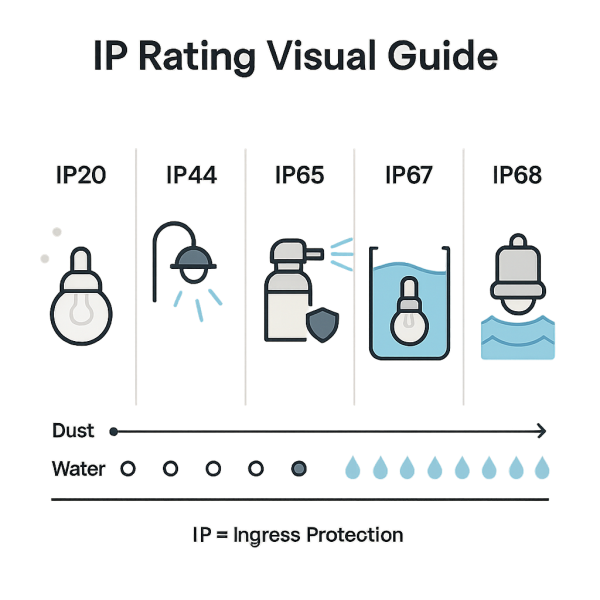
The rating differs from other trade specifications because it is incredibly systematic. The code always consists of the letters IP followed by two distinct digits (e.g., IP44, IP65, or IP67). Each digit represents a specific form of environmental defence.
The First Digit: Solids and Dust
The first number indicates the level of protection against solid foreign objects. The scale ranges from 0 (no protection) to 6 (completely dust-tight).
- 0–2: Generally offers little to no protection against small items. These ratings are typical for indoor lights where only fingers or large tools are the primary concern.
- 3–4: Protects against solid objects larger than 2.5mm and 1mm respectively. An IP4x rating is significant for outdoor use because it prevents the entry of most wires, screws, and even large ants or insects, which can cause internal short circuits.
- 5: Dust-protected. Limited dust may enter, but not in sufficient quantity to interfere with the satisfactory operation of the equipment.
- 6: Dust-tight. No ingress of dust is permitted at all. This is the gold standard for harsh environments or coastal areas where salt spray and sand are factors.
The Second Digit: Moisture and Water
For outdoor lighting in Britain, the second number is arguably the most critical. It measures protection against water, ranging from 0 (no protection) to 9 (high-pressure, high-temperature jets). Most domestic outdoor lighting falls between 4 and 8.
- 4 (Splashing Water): Liquid splashed from any direction shall have no harmful effect. This is the minimum requirement for most outdoor wall lights that are somewhat sheltered by a porch or eaves.
- 5 (Water Jets): Protects against water projected by a nozzle (6.3 mm) against the enclosure from any direction. This is essential for lights that are fully exposed to driving rain or might be inadvertently cleaned with a low-pressure garden hose.
- 6 (Powerful Water Jets): Water projected in powerful jets (12.5 mm nozzle) against the enclosure shall have no harmful effects. This is rare for decorative garden lights but common for industrial floodlights.
- 7 (Immersion): Protects against the effects of temporary immersion in water between 15cm and 1 metre for 30 minutes. This is technically required for decking lights or ground lights that may briefly sit in a puddle during a storm.
- 8 (Submersion): Suitable for continuous immersion in water under conditions specified by the manufacturer. This is mandatory for underwater lighting in ponds, fountains, or swimming pools.
Why Zoning Matters
It is a common misconception that an IP68 light is simply "better" than an IP44 light for all scenarios. While it offers higher protection, it may be over-engineered (and significantly more expensive) for a sheltered front door location. Conversely, installing an IP44 fitting in a ground-level pathway is dangerous, as standing water will eventually breach the seal.
By decoding these numbers, you ensure you match the fixture to its specific location—a process often referred to in safety guidelines as zoning—ensuring your external lighting setup remains safe, functional, and waterproof for years to come.
The First Digit: Protection Against Solid Objects (Dust, Tools)
When you are selecting the perfect illumination for your garden or driveway, the technical specifications can often seem like an impenetrable code. However, deciphering the Ingress Protection rating is straightforward once you understand the hierarchy. The first digit of the IP code specifically indicates the level of defence the enclosure provides against the intrusion of solid foreign objects. This scale ranges from 0 (no protection) to 6 (dust-tight).
While it is often tempting to focus primarily on water resistance given the notoriously wet weather in the UK, the first digit is critical for two interconnected reasons: safety and longevity.
From Fingers to Fine Particles
It is a common misconception that this digit refers solely to dust. In reality, the lower numbers on the scale are specifically designed to prevent accidental contact with hazardous parts, such as live electrical conductors. This logical progression is defined by the International Electrotechnical Commission (IEC) standards.
- Levels 1 to 4: These ratings protect against larger items. For instance, IP2X ensures a human finger (or objects up to 12.5mm) cannot access internal components—a vital safety baseline for any household item. Moving up, IP4X guarantees protection against solid objects larger than 1mm. In a garden setting, this effectively stops wires, large insects, or small garden tools from accidentally damaging the internal circuitry or causing an electric shock.
The Gold Standard for Outdoors: IP5X vs IP6X
For nearly all robust outdoor lighting solutions, you should be strictly looking at a first digit of either 5 or 6. Anything lower than a 4 is generally unsuitable for exterior use unless the fixture is housed within a deeply sheltered porch or portico.
IP5X: Dust Protected
An enclosure rated as 5 offers significant protection. It does not promise to entirely prevent dust entry, but it guarantees that dust will not enter in sufficient quantity to interfere with the satisfactory operation of the equipment. For wall lights mounted high up or under soffits, IP5X is often sufficient. It handles general accumulation of environmental dirt and prevents insects from nesting inside the housing, which is a frequent cause of failure in lower-rated fittings.
IP6X: Dust Tight
This is the highest level of protection available against solid ingress. A rating of 6 means there is absolutely no ingress of dust; it is completely vacuum-sealed against contact. Typically, fixtures with this rating are tested under vacuum conditions to ensure air cannot pass through gaskets or seals.
Why High Solid Object Protection Matters in the UK
Why is an IP6X rating necessary if we do not live in a desert environment? The answer lies in the microscopic nature of electronic damage. In the UK, outdoor lights are subjected to wind-blown grit, pollen, and fine soil particles.
If fine dust penetrates a sophisticated lighting fixture, it can coat the LED heat sink, acting as a thermal insulator. This prevents the LED from dissipating heat effectively, which is the primary cause of premature LED failure. Furthermore, damp dust can become conductive, potentially causing short circuits inside the driver.
For ground lights, decking lights, or well lights buried in the soil, IP6X is non-negotiable. These fittings are constantly surrounded by dirt and debris. According to general guidance from Electrical Safety First, ensuring your outdoor electrical equipment is fit for its specific environment is paramount to preventing fire hazards and electric shocks.
Summary Table of First Digit Ratings for Outdoor Lighting:
| First Digit | Protection Description | Typical Application |
|---|---|---|
| 4 | Protected against objects >1mm (wires, large ants) | Sheltered porches, soffits |
| 5 | Dust protected (limited ingress permitted) | Wall lanterns, high-mounted fence lights |
| 6 | Dust tight (no ingress) | Ground lights, exposed floodlights, path lights |
In conclusion, when purchasing high-quality outdoor lighting, do not overlook the first number. A minimum of IP44 is standard for general use, but aiming for IP65 or IP67 ensures that the internal components remain pristine, free from the damaging accumulation of British garden grit.
The Second Digit: Protection Against Liquids (Water)
While the first digit of the IP rating safeguards the internal components from solid foreign objects, the second digit is arguably the most critical variable for homeowners in the United Kingdom. This figure indicates the level of protection the enclosure offers against the ingress of liquids—primarily water in the context of garden lighting. Given the infamous British climate, where precipitation ranges from fine misty drizzle to torrential downpours, selecting the correct liquid protection rating is essential for preventing short circuits, corrosion, and dangerous electrical failures.
The scale for the second digit ranges from 0 (no protection) to 9 (protection against high-pressure, high-temperature water jets). However, for domestic outdoor lighting applications, you will most commonly encounter ratings between 4 and 8. Understanding the nuances between these numbers can make the difference between a light fixture that lasts a decade and one that fails after the first wet winter.
Validating the Waterproof Ratings
To help you decipher which rating suits your specific garden zones, here is a detailed breakdown of the relevant liquid protection levels:
- Level 4 (e.g., IP44): Protection against splashing water.
fixtures rated with a '4' as the second digit are protected against water splash from any direction. This is often the industry standard for decorative wall lights situated under porches, eaves, or soffits. While they can handle a rain shower, they are not designed to withstand pressurised jets or standing water. - Level 5 (e.g., IP65): Protection against water jets.
This signals a significant step up in defence. An IPx5 fixture can withstand water projected by a nozzle (6.3mm) from any direction—think garden hoses or low-pressure sprinklers. For exposed areas of the garden, such as spike lights in flower beds or wall lights on a fence without overhead cover, Level 5 is generally the minimum recommendation in the UK. - Level 6 (e.g., IP66): Protection against powerful water jets.
If you live in a coastal area prone to driving rain and heavy winds, or if you regularly clean your patio areas with a pressure washer, you should look for a '6' as the second digit. These enclosures are tightly sealed against powerful jets (12.5mm nozzle), ensuring that high-velocity water does not penetrate the housing. - Level 7 (e.g., IP67): Protection against temporary immersion.
This is the crucial tipping point for ground lighting. An IP67 rating ensures the unit can be submerged in water up to 1 metre deep for 30 minutes. In the UK, drainage can be an issue; driveways and decking areas often accumulate standing water during storms. If you are installing recessed ground lights, an IP67 rating acts as a vital insurance policy against puddles. - Level 8 (e.g., IP68): Protection against continuous immersion.
For lighting installed directly inside ponds, water features, or swimming pools, only IP68 will suffice. These units are hermetically sealed and designed to operate while permanently submerged under pressure. Manufacturers will specify the maximum depth for these fittings, so always check the technical datasheet.
The Importance of Drainage
It is vital to note that a high IP rating is not a substitute for proper installation. Even an IP67 fitting can fail if it sits in a waterlogged hole for weeks on end. When installing driveway or decking lights, ensure your electrician follows the BS 7671 Wiring Regulations (maintained by the Institution of Engineering and Technology) regarding adequate drainage layers beneath the fitting. Gravel soakaways assist the water in draining away from the seal, reducing the hydrostatic pressure on the gaskets.
In summary, while an IP44 rating might suffice for a sheltered front door light in Surrey, a coastal property in Cornwall or a decking light in the Scottish Highlands will demand the robust protection of IP65 or IP67 respectively. Always audit the environment before purchasing to ensure your lighting scheme remains brilliant, come rain or shine.
IP Ratings Explained: Common Ratings & What They Mean (IP23, IP44, IP65, IP67, IP68)
When specifying hardware for the unpredictable British climate, understanding the Ingress Protection (IP) code system is paramount. Defined by the standard IEC 60529, an IP rating consists of two digits that determine exactly how well an electrical enclosure can withstand the intrusion of foreign bodies (dust/dirt) and moisture (rain/submersion).
The structure is straightforward but critical for safety regulations:
- The First Digit (0–6): Indicates protection against solid objects (ranging from hands to fine dust).
- The Second Digit (0–9): Indicates protection against liquids (ranging from condensation to high-pressure jets and immersion).
Below is a breakdown of the specific ratings you will most frequently encounter when shopping for garden and exterior lighting in the UK, progressing from basic protection to fully submersible units.
IP23: Rain-Proof / Spray-Proof
While less common for modern garden installations, IP23 is often found on traditional, heritage-style lanterns designed for covered porches. The '2' indicates protection against fingers or objects larger than 12mm, while the '3' denotes protection against spraying water at an angle of up to 60 degrees from the vertical.
- Best Use: Covered front door areas or soffits where the fitting is sheltered from direct, driving rain.
- Warning: These are not suitable for exposed garden walls facing the prevailing wind.
IP44: Splash-Proof (The Industry Standard)
IP44 is the most ubiquitous rating for general domestic outdoor lighting in the UK. The '4' ensures protection against solid objects larger than 1mm (including wires and large ants), while the second '4' guarantees protection against water splashes from all directions.
- Best Use: Standard wall lights, motion sensor (PIR) lights, and door lighting.
- Suitability: It can withstand typical British rain, provided the unit is not jet-washed or installed at ground level where snow might pile up.
IP65: Jet-Proof and Dust Tight
For more exposed locations, or for commercial-grade peace of mind, IP65 is the superior choice. The '6' represents the highest level of solid ingress protection—completely dust tight—preventing any internal accumulation of debris. The '5' indicates the fitting can withstand low-pressure water jets (6.3mm) from any direction.
- Best Use: Security floodlights, spotlights located in open gardens, and coastal lighting where wind-driven rain is frequent.
- Cleaning: You can safely clean these fittings with a standard garden hose (though not a high-pressure power washer).
IP67: Temporary Immersion
Lighting installed at ground level faces significant challenges, including puddles and temporary flooding during heavy storms. IP67 fittings are totally dust tight and rated for temporary immersion in water up to 1 metre deep for 30 minutes.
- Best Use: Decking lights, driveway marker lights, and walkover ground lights.
- Installation Note: While they can handle being submerged, you must install adequate drainage (a soakaway) beneath IP67 ground lights to prevent them from sitting in water permanently, which eventually degrades the seals.
IP68: Continuous Immersion
This is the highest standard for consumer-grade water ingress protection. IP68 denotes equipment that is hermetically sealed and suitable for continuous immersion in water beyond 1 metre (depth specifications are usually provided by the manufacturer).
- Best Use: Swimming pool lighting, pond lights, and water feature illumination.
- Requirement: These units must be essentially watertight under pressure indefinitely.
For further technical details on the classification standards, you can refer to the International Electrotechnical Commission (IEC) guidelines or consult the Institution of Engineering and Technology (IET) for specific wiring regulations relating to special locations.
Matching IP Ratings to Location: Garden, Pathway, Driveway, Pond
When designing a lighting scheme for a British garden, one size certainly does not fit all. The erratic nature of UK weather—shifting rapidly from glorious sunshine to torrential down,purs—means that the specific placement of a luminaire dictates its required Ingress Protection (IP) rating. A light fitting perfectly safe for a sheltered porch could be legally and electrically dangerous if installed inside a water feature.
To ensure safety and longevity, you must assess the environmental zone where the light will sit. Here is a breakdown of the minimum and recommended IP ratings for common outdoor zones across your property.
1. General Garden and Patio Areas (Wall Lights & Festoons)
For general ambient lighting, such as wall lanterns flanking a back door or festoon lights draped over a pergola, you are generally looking at protection against rain at oblique angles.
- Minimum Requirement: IP44
- Recommendation: IP44 to IP55
An IP44 rating ensures the fitting is protected against solid objects larger than 1mm and water splashing from any direction. For fixtures installed under soffits or eaves where they are shielded from direct rainfall, this is sufficient. However, if the wall is particularly exposed to driving wind and rain, upgrading to IP55 serves as a better barrier against low-pressure water jets and dust deposits.
2. Pathways and Flower Beds (Spike & Bollard Lights)
Lighting along a pathway or nestled within flower beds faces different challenges than wall-mounted fixtures. These units sit closer to the ground, making them susceptible to mud splashes during heavy rain, sprinklers, and damp soil conditions.
- Minimum Requirement: IP44
- Recommendation: IP65
While IP44 is the technical minimum, we strongly advise using IP65 for ground-level pathway lights. An IP65 rating means the unit is “dust tight” and protected against water jets. This is crucial if you use a hosepipe to water the garden, as an accidental direct spray could penetrate lower-rated fittings. Furthermore, insects are notoriously attracted to light sources; the dust-tight seal of an IP65 fixture prevents bugs from entering and dying inside the lens, which can ruin the aesthetic and overheat the lamp.
3. Driveways and In-Ground Lighting
Driveway lighting is perhaps the most demanding application outside of water features. These fittings (often ground lights or “well lights”) must withstand two major threats: temporary submersion caused by puddling (common on uneven British tarmac) and high-pressure cleaning.
- Minimum Requirement: IP65
- Recommendation: IP67
IP67 is the gold standard here. It indicates the unit can withstand temporary immersion in water between 15cm and 1 metre for up to 30 minutes. This is vital when washing your car with a pressure washer or during those autumnal storms where drainage systems struggle to keep up.
Important Installation Note: even with IP67 lights, adequate drainage substrate (gravel) must be installed beneath the fitting. For guidance on electrical safety outdoors, refer to the Electrical Safety First advice guides.
4. Ponds and Water Features (Submersible)
Any lighting installed within a pond, fountain, or swimming pool falls into a critical safety category. Water and electricity are a lethal combination, and the regulations here are strict (referencing BS 7671 Wiring Regulations).
- Minimum & Mandatory Requirement: IP68
IP68 denotes protection against continuous submersion in water. However, unlike other ratings, IP68 is manufacturer-dependent regarding depth and pressure. You must check the “maximum depth” specification on the box. A light rated IP68 for 1 metre cannot be installed at the bottom of a 3-metre deep pool.
When dealing with pond lighting, these fixtures should also operate at a generic Safe Extra Low Voltage (SELV)—typially 12V or 24V—to eliminate the risk of electric shock should the housing integrity fail. Always consult a registered electrician for installation in these zones.
Summary Table
| Location | Threat | Recommended Rating |
|---|---|---|
| Porch/Sheltered Wall | Damp air / Splashes | IP44 |
| Exposed Patio | Driving Rain | IP55 - IP65 |
| Pathways | Hosepipes / Mud | IP65 |
| Driveways | Puddles / Pressure Wash | IP67 |
| Inside Pond | Submersion | IP68 |
Choosing Lights for Different Weather Conditions: Coastal Areas vs. Inland
When identifying how to choose the right IP rating for outdoor lighting in the UK, one must look beyond simple ingress protection numbers and consider the specific geographical environment. The United Kingdom’s weather is notoriously variable, but the distinction between a sheltered suburban garden in the Midlands and an exposed seafront property in Cornwall is stark. The longevity of your external luminaires depends heavily on matching both the IP rating and the material construction to your specific location.
The Coastal Challenge: Salt Spray and Corrosion
If you reside within ten miles of the coast, your lighting fixtures face an aggressive adversary: saline corrosion. In these environments, salt-laden winds can rapidly degrade standard outdoor fittings, causing them to rust, pit, and eventually fail electrically.
While an IP65 or IP67 rating guarantees that the unit is sealed against high-pressure water jets or immersion, it does not guarantee that the casing itself will survive the salt air. For coastal applications, the material is just as critical as the IP rating. You should prioritise the following materials:
- 316 Marine Grade Stainless Steel: Unlike the standard 304 grade used in many kitchen appliances, 316 stainless steel contains molybdenum, which significantly increases corrosion resistance against chlorides (salt).
- Solid Copper or Brass: These natural metals are exceptionally durable. Over time, they will develop a verdigris patina (a greenish layer) which actually acts as a protective shield against further corrosion.
- Polycarbonate and Heavy-Duty Plastics: High-quality black or white polycarbonate fittings are immune to rust and are often UV stabilised to prevent fading or brittleness.
- Galvanised Steel: This offers a rugged, industrial aesthetic and provides a self-healing zinc coating that protects the steel beneath.
regarding the IP rating specifically for coastal zones, aim for a minimum of IP65. Coastal storms often bring horizontal rain driven by gale-force winds. An IP44 rating, which is splash-proof, may not be sufficient to withstand the sheer pressure of wind-driven precipitation found on the shoreline.
Inland Considerations: Rain, Frost, and Placement
For properties located inland, away from the corrosive influence of the sea, the priorities shift slightly. While you must still contend with the famously damp British weather, the lack of salt spray widens your choice of materials. Here, standard powder-coated aluminium or 304 stainless steel are perfectly acceptable choices.
However, the IP rating decision inland should be driven by placement and exposure:
- Sheltered Areas (Porches and Soffits): If you are installing downlights in a soffit or a wall lantern under a generous porch, an IP44 rating is standard and sufficient. These fittings are protected from direct jets of water and heavy rainfall.
- Exposed Walls and Gardens: For wall lights that have no overhead cover, or for path lights exposed to the elements, you should step up to IP65. This ensures complete protection against rain from any direction.
- Ground-Level Lighting: Inland areas are often prone to frost and standing water. If you are installing decking lights or ground spikes, you must consider drainage. Even inland, a garden light submerged in a puddle requires IP67 (temporary immersion) or IP68 (continuous subversion). Furthermore, the freeze-thaw cycle can compromise seals on cheaper fittings, so investing in high-quality rubber gaskets is essential to prevent moisture ingress when the ice melts.
Ultimately, whilst the British Standard for wiring (BS 7671) dictates safety zones for bathrooms, outdoor zoning is less strictly regulated but physically more demanding. By assessing whether you are fighting salt corrosion on the coast or general moisture ingress inland, you safeguard your investment and ensure your property remains safely illuminated through the darkest winter nights.
Low Voltage vs. Mains Voltage Lighting & IP Ratings
When designing an outdoor lighting scheme for a British garden, homeowners are faced with a slightly technical—yet crucial—decision: should you opt for mains voltage (230V) or low voltage (12V or 24V) systems? While the aesthetic output can look identical to the naked eye, the implications for installation, safety, and Ingress Protection (IP) strategies differ significantly.
The Mains Voltage (230V) Perspective
Mains voltage lighting connects directly to your home’s electrical supply without the need for a step-down transformer. This is the traditional standard for wall lights, security floodlights, and permanent post lights. However, because 230V electricity carries a significant risk of electrocution if compromised, the IP rating becomes a matter of critical life safety.
If water breaches a mains voltage fitting due to a poor IP rating (e.g., using an IP44 light in an area requiring IP65), it will almost certainly trip your home’s RCD (Residual Current Device), plunging your entire circuit into darkness. In worst-case scenarios, water ingress can make metal casings live. Consequently, installing mains voltage cabling in the garden requires strict adherence to Part P of the Building Regulations. Cables must be steel-wire armoured (SWA) and buried deep underground to prevent accidental strikes from garden tools. For this reason, we strongly recommend consulting a registered electrician via the Electrical Safety First register for any 230V installation.
The Low Voltage (12V/24V) Advantage
Conversely, low voltage systems use a driver or transformer to step the mains current down to a safer 12V or 24V. This is increasingly popular in purely decorative landscape lighting because it significantly reduces the shock hazard. However, a common misconception is that because the voltage is "safe," the waterproofing (IP rating) matters less. This is a myth.
While a 12V shock in a wet environment is unlikely to be fatal, water ingress remains the primary killer of LED durability. If an outdoor spotlight has an insufficient IP rating, moisture will enter the housing and corrode the printed circuit board (PCB) or the LED COB itself. Furthermore, low voltage DC current in the presence of water accelerates galvanic corrosion on terminals and wire connections. Therefore, just because the voltage is low, you should not settle for anything less than IP65 for exposed garden spikes or IP67 for recessed ground lights.
The Weak Link: Transformers and Junctions
When dealing with low voltage systems, the IP rating focus often shifts to the components between the lights:
- The Transformer/Driver: Unless your transformer is rated IP67 or higher, it cannot be left exposed in a flowerbed. Standard IP20 drivers must be housed in a waterproof enclosure (often called a 'wiska box') or kept indoors (e.g., in a garage or shed).
- Cable Joins: The most common point of failure is not the light fitting, but the cable join. Wrapping tape around a connection is insufficient for the UK's damp climate. You must use IET-compliant resin-filled joint kits or IP68 gel connectors to ensure the integrity of the loop.
Summary Table: Voltage and IP Considerations
| Feature | Mains Voltage (230V) | Low Voltage (12V/24V) |
|---|---|---|
| Installation | Strict; requires armoured cable & Electrician (Part P). | Flexible; DIY-friendly cabling often allowed. |
| Safety Risk | High; potential for electrocution. | Low shock risk. |
| IP Rating Priority | Critical for safety and functionality. | Critical for component longevity and corrosion prevention. |
| Ideal Use | Wall lights, high-power floodlights, post lights. | Garden spikes, mood lighting, deck lights. |
In conclusion, whether you choose the robust power of mains voltage or the flexibility of low voltage, the British weather is unforgiving. Always match the IP rating to the specific zone of the garden (see our previous section on Zoning), regardless of the voltage running through the wires.
UK Regulations & Electrical Safety for Outdoor Lighting
While selecting the correct Ingress Protection (IP) rating is the first step towards a waterproof lighting setup, it is only one component of a safe electrical installation. In the United Kingdom, installing electricity outdoors is subject to strict regulatory frameworks designed to prevent shock, fire, and degradation caused by the volatile British weather. Unlike indoor wiring, outdoor environments introduce risks such as water ingress, UV radiation, and mechanical damage from gardening tools or wildlife. Ignoring these rules not only endangers life but can also invalidate your home insurance policies.
Understanding BS 7671 (The IET Wiring Regulations)
At the heart of all electrical work in the UK lies BS 7671, commonly known as the IET Wiring Regulations (currently in its 18th Edition). While these regulations are technically non-statutory, complying with them is the primary method of demonstrating that you have met the requirements of the Electricity at Work Regulations 1989.
For outdoor lighting, BS 7671 dictates specific measures regarding 'External Influences'. This section of the regulations explicitly requires that equipment must be selected and erected so that it can withstand the environmental conditions—specifically water ingress (classified as AD) and foreign solid objects (classified as AE). This is the regulatory backbone that makes choosing the correct IP rating (e.g., IP65 or IP67) a mandatory safety requirement rather than just a product feature.
Part P of the Building Regulations
For homeowners in England and Wales, Part P of the Building Regulations is perhaps the most critical legal consideration. Part P ensures that electrical installation work in a dwelling is safe.
Crucially, the installation of a new circuit for outdoor lighting, or running electricity to a detached outbuilding like a shed or summerhouse, is typically classified as 'notifiable work'. This means you have two primary routes to compliance:
- Hire a Registered Competent Person: An electrician registered with a government-approved scheme provider (such as NICEIC or NAPIT) can self-certify their work and issue you a compliance certificate directly.
- Notify Building Control: If you do the work yourself or use an unregistered electrician, you must notify your local authority's Building Control department before work starts and pay for an inspection.
More details on consumer rights and notification can be found via the Planning Portal.
Cabling and Mechanical Protection
Simply keeping water out of the light fitting isn't enough; the power supply must be equally robust. Standard PVC 'twin and earth' cable, commonly used indoors, is not suitable for use outdoors unless it runs inside a dedicated conduit system. Over time, UV rays degrade standard PVC, making it brittle and liable to crack, exposing live conductors.
For most garden lighting projects involving underground runs, Steel Wire Armoured (SWA) cable is the industry standard. This cable features a galvanised steel wire sheath that provides significant mechanical protection against gardening tools (like spades), wildlife (such as foxes or rodents chewing cables), and soil movement.
Regulations generally suggest that underground cables should be buried at a sufficient depth to avoid damage from disturbance of the ground—typically 600mm for potentially dangerous voltages—and covered with yellow electrical warning tape roughly 150mm above the cable to alert anyone digging in the future.
Weatherproof Switching and RCD Protection
Regardless of the IP rating of your light fixture, the circuit supplying it must have Residual Current Device (RCD) protection. An RCD is a life-saving device designed to prevent fatal electric shocks only. It works by detecting the slightest current leakage (often caused by dampness entering a fitting or a cut cable) and cutting the power essentially instantly (within milliseconds).
Under the 18th Edition regulations, any socket outlet rated at 32A or less, including outdoor sockets used for plug-in lighting, must be protected by a 30mA RCD. Furthermore, from a practical standpoint, all outdoor lighting circuits should ideally be on their own RCD-protected circuit or RCBO (Residual Current Breaker with Overcurrent). This segregation prevents an outdoor fault (caused by a heavy rainstorm, for example) from tripping the main fuse board and cutting power to your fridge, freezer, or indoor lights.
Verification and Certification
Finally, upon completion of the installation, a registered electrician must test the circuit to ensure the Earth Loop Impedance is low enough to trigger safety devices and that the insulation resistance is high. You should receive an Electrical Installation Certificate (EIC) or a Minor Electrical Installation Works Certificate (MEIWC) depending on the scope of the job. Keep this document safe; solicitors will almost certainly request it if you ever decide to sell your property, as proof that the external lighting complies with UK law.
Disclaimer: This guide provides an overview of current UK regulations but does not constitute professional advice. Electrical regulations are subject to change. Always consult a qualified, registered electrician for outdoor installations.
Maintaining Outdoor Lighting & IP Rating Integrity
Selecting the correct Ingress Protection (IP) rating for your garden or architectural lighting is theoretically the most critical step in your purchasing journey. However, even an IP68-rated submersible fixture can fail if the integrity of that rating is compromised during installation or through lack of maintenance. In the volatile UK climate, where fittings face everything from torrential autumn downpours to freezing winter frosts and occasional summer heatwaves, maintaining the physical seal of your lighting is paramount to safety and longevity.
The Importance of Correct Installation
A common misconception is that a high IP rating guarantees a waterproof unit straight out of the box, regardless of how it is connected. In reality, water ingress most frequently occurs not through the lens or body of the light, but through the cable entry point. If you utilise standard connectors rather than specialised IP68 cable glands or gel-filled junction boxes, you are effectively creating a roadmap for moisture to travel into the fitting.
Furthermore, when installing wall lights or floodlights, one must always employ a 'drip loop'. This involves allowing the power cable to dip below the level of the cable gland before entering the fitting. This simple gravity-based measure ensures that rainwater runs down the cable and drops off the bottom of the loop, rather than tracking directly into the light fixture. Without this, capillary action can draw water through the microscopic gaps in a cable gland, eventually short-circuiting the driver or bulb.
Cleaning Protocols: Avoid the Pressure Washer
When spring cleaning patios and driveways, it is tempting to clean outdoor lanterns and bulkheads with a pressure washer. This is a significant error that often voids warranties.
- IP44 & IP65 Limitations: An IP65 rating offers protection against low-pressure water jets from any direction. It is not designed to withstand the high-velocity impact of a domestic pressure washer, which can force water past rubber gaskets and silicone seals.
- The Solution: Clean stainless steel, aluminium, or polycarbonate fittings with warm, soapy water and a soft, non-abrasive cloth. For stainless steel in coastal areas (where salt air accelerates corrosion), applying a protective oil specifically designed for metal maintenance is advisable.
Checking Seals and Gaskets
Over time, UV radiation from the sun and the expansion-contraction cycles caused by British temperature fluctuations can degrade the rubber gaskets and O-rings that provide the waterproof seal.
During your bi-annual maintenance check (ideally in late Spring and early Autumn), inspect the rubber seals for signs of cracking, brittleness, or perishing. If a seal looks compromised, moisture will inevitably breach the enclosure. Many reputable manufacturers supply spare gasket kits; replacing a 50p rubber ring is significantly more cost-effective than replacing an entire architectural spotlight.
Condensation vs. Ingress
It is vital to distinguish between a seal failure (ingress) and condensation. All outdoor lights containing air will experience some level of internal condensation as the internal temperature rises (when the light is on) and falls (when it is off), drawing in damp air which then condenses on the cold lens.
High-quality integrated LED fittings often feature breathable membranes or valves that allow air pressure to equalise and moisture to escape without letting water in. If you notice persistent fogging that does not clear when the light warms up, check your seals immediately. For more information on electrical safety outdoors, you can consult resources such as Electrical Safety First.
By treating the IP rating as a standard that must be actively maintained rather than a 'fit and forget' feature, you ensure your exterior lighting scheme remains safe, functional, and visually stunning for years to come.
Where to Buy & Professional Installation Recommendations
Securing the longevity and safety of your outdoor lighting scheme depends just as much on where you purchase your fixtures and who installs them as it does on the IP rating itself. In the UK market, the disparity in quality between certified, professional-grade lighting and cheap, non-compliant imports can be significant. Furthermore, given the strict electrical safety codes in Great Britain, proper installation is not merely a recommendation—it is often a legal requirement.
Sourcing Reputable IP-Rated Fixtures
When purchasing outdoor lighting, it is advisable to look beyond generic high-street marketplaces or potentially unverified third-party sellers on large e-commerce platforms. While these may offer attractive price points, the IP ratings claimed on budget units are frequently untested or exaggerated. A fixture might claim IP65 waterproofing, but if the rubber gaskets degrade under UV exposure within three months, water ingress will inevitably occur.
Instead, prioritise specialist lighting retailers and established electrical wholesalers (such as TLC Electrical Supplies or Lighting Direct). These vendors typically stock reputable brands that provide detailed technical data sheets and robust warranties.
Key Indicators of Quality:
- UKCA / CE Marking: Ensure the product bears the UKCA (UK Conformity Assessed) or CE mark. This indicates the product meets the essential health, safety, and environmental protection standards for products sold within Great Britain and the EEA.
- Material Quality: Look for marine-grade stainless steel (316 grade) or heavy-duty powder-coated aluminium for longevity in the damp British climate. Plastic housings can become brittle and crack during frost, compromising the IP barrier.
- Spare Parts Availability: Reputable suppliers will often allow you to buy replacement seals or lenses, whereas generic 'throwaway' units do not.
The Critical Importance of Professional Installation
Even an IP68-rated submersible spotlight will fail if the cable connections are not watertight. The most common point of failure in outdoor lighting is not the manufacturing of the light, but the joint where the power cable enters the fitting. If this is not sealed correctly using proper glands, resin-filled joint kits, or IP-rated junction boxes, moisture will travel up the cable (capillary action) and short the circuit.
Compliance with Building Regulations (Part P):
In England and Wales, electrical work is governed by Part P of the Building Regulations. While changing a bulb is unrestricted, installing new circuits or adding lighting in 'special locations' (which includes many garden areas or zones near water features) is classified as notifiable work.
Attempting complex outdoor wiring as a DIY project carries severe risks, including electrocution and fire. Furthermore, illegal electrical work can invalidate your home insurance and cause significant issues when trying to sell your property, as you will lack the necessary compliance certificates.
Finding a Competent Electrician
To ensure your installation is safe, legal, and creates a lasting seal against the elements, you should always employ an electrician registered with a government-approved Competent Person Scheme. This allows them to self-certify their work and issue you with a Building Regulations Compliance Certificate directly.
Recommended registries to search include:
- NICEIC: The National Inspection Council for Electrical Installation Contracting is one of the most recognised bodies in the UK.
- NAPIT: The National Association of Professional Inspectors and Testers.
- The Electrical Safety First Register: A strictly vetted database of registered electricians.
When hiring, specifically ask about their experience with outdoor lighting. An experienced sparky will know to use Steel Wire Armoured (SWA) cable to prevent rodent damage and will understand the necessity of RCD (Residual Current Device) protection to prevent a single damp garden light from tripping the power to your entire house.
By combining high-quality fixtures from trusted UK suppliers with the expertise of a registered electrician, you ensure that your selected IP rating performs exactly as intended, keeping your garden illuminated and your home safe for years to come.